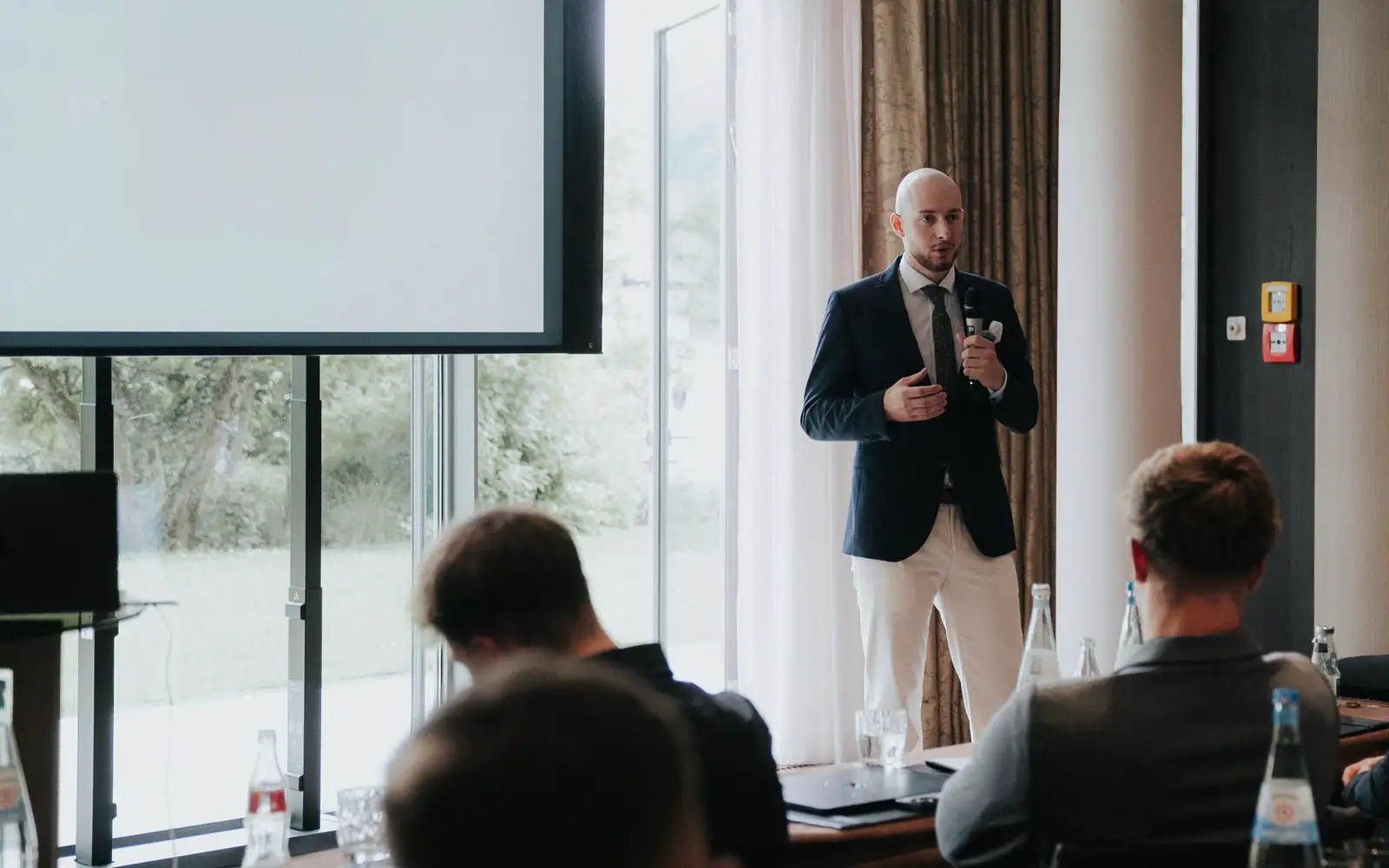
A client conversation shapes how competent your company comes across. In my trainings, your employees learn to come across with confidence, understand clients better and handle difficult conversations professionally.Hands-on trainings where your employees come across with confidence and understand clients better.
- Win over new clients
- Keep existing clients
- Encourage referrals
Typical challenges
Strong expertise.
But does it land with the client?
Expertise alone doesn't convince. How your employees come across, listen and respond shapes clients' trust in your company.
- 01 First impression
Uncertain presence
Your employees know what they offer, but don't always come across as confident and convincing in client meetings.
- 02 Spotting needs
Lack of client understanding
Needs and expectations aren't fully recognized or explored with the right questions.
- 03 Explaining the offer
Unclear value
Services get explained in technical terms, but the concrete value for the client stays unclear.
- 04 Critical moments
Difficult conversations
Tough questions, objections, price discussions and complaints create uncertainty.
- 05 After the deal
Untapped client loyalty
Even after the deal is closed, communication shapes how clients experience working with you.
- 06 Referral
Missed referrals
Satisfied clients aren't asked about possible referrals at the right moment.
Professional client communication starts with the first impression and doesn't end when the deal is closed.
The shared goal
More convincing client conversations. Stronger client relationships.
Your employees come across with more confidence in client contact, build trust and strengthen new and existing client relationships.
No sales lines, but communication skills you can put into practice.
The improvements we aim for:
- More confidence in client meetings
- More trusting, better structured conversations
- Better understanding of client needs
- Clearer presentation of your services
- Handling objections and complaints with confidence
- Stronger client loyalty, more referrals
The training focus areas
Communication that builds trust
and strengthens client relationships.
I choose the specific focus areas to fit your employees and your typical client situations.
- 01
Confidence in client meetings
Come across with confidence and build trust from the start.
Body language, voice, tone and personal presence shape how competent your employees come across in a conversation.
Practical examplePractice a realistic conversation opener, reflect on your own impact and try out different ways of expressing yourself.
- 02
Trust & conversation skills
Listen, ask follow-up questions and truly understand clients.
Trust comes from attention, clarity and a professionally structured conversation.
Practical exampleSimulate a consultation, ask targeted questions about client needs and sum up the key points clearly.
- 03
Mastering difficult conversations
Stay calm and professional with objections, criticism and complaints.
Not every conversation goes smoothly. What matters is how your employees communicate under pressure.
Practical exampleTrain a critical client conversation as a role-play and test alternative phrasing right away.
- 04
Client loyalty & referrals
Strengthen relationships, even after the first deal.
Existing client relationships are shaped by appreciative communication, reliability and a professional way of handling questions.
Practical exampleWork through a demanding situation with an existing client or bring up a referral in the right way.
- 05
Coming across as competent & convincing
Get your expertise across clearly and convincingly.
Your employees learn to structure what they say clearly and explain services so the client understands their value.
Practical exampleExplain a complex offer in simple terms and present the concrete value for the client clearly.
- 06
Presentation skills
Present products, services and solutions with impact.
Especially in consulting and sales, what counts is presenting information in a clear, structured way and with confident personal impact.
Practical exampleGive a short client presentation, get feedback on voice, body language and structure, and then improve the delivery.
01 · Confidence in client meetings
Come across with confidence and build trust from the start.
Body language, voice, tone and personal presence shape how competent your employees come across in a conversation.
Practical examplePractice a realistic conversation opener, reflect on your own impact and try out different ways of expressing yourself.
02 · Trust & conversation skills
Listen, ask follow-up questions and truly understand clients.
Trust comes from attention, clarity and a professionally structured conversation.
Practical exampleSimulate a consultation, ask targeted questions about client needs and sum up the key points clearly.
03 · Mastering difficult conversations
Stay calm and professional with objections, criticism and complaints.
Not every conversation goes smoothly. What matters is how your employees communicate under pressure.
Practical exampleTrain a critical client conversation as a role-play and test alternative phrasing right away.
04 · Client loyalty & referrals
Strengthen relationships, even after the first deal.
Existing client relationships are shaped by appreciative communication, reliability and a professional way of handling questions.
Practical exampleWork through a demanding situation with an existing client or bring up a referral in the right way.
05 · Coming across as competent & convincing
Get your expertise across clearly and convincingly.
Your employees learn to structure what they say clearly and explain services so the client understands their value.
Practical exampleExplain a complex offer in simple terms and present the concrete value for the client clearly.
06 · Presentation skills
Present products, services and solutions with impact.
Especially in consulting and sales, what counts is presenting information in a clear, structured way and with confident personal impact.
Practical exampleGive a short client presentation, get feedback on voice, body language and structure, and then improve the delivery.
How we work in the training
Don't just understand client conversations.
Train them in practice.
The focus is on the real client situations your employees face.
Understand your client situations
In a short preliminary call, we clarify your target group, typical client contacts, challenges and focus areas.
Understand
Participants see what builds trust and how their communication comes across.
Apply
Client conversations, tough questions and complaints are trained in realistic exercises.
Review
Individual feedback on body language, tone, word choice and conversation structure.
Improve
Try new phrasing and set concrete steps for future client conversations.
Our standard
Less lecturing More real conversations
Two training formats
Two formats. Tailored to your team.
Impulse talk
First impressions count.
- 90 minutes
An interactive talk that makes your employees aware of client communication. With first practical tools.
Included in the talk:
- Short preliminary call
- Insights into presence, client understanding and conversation skills
- Practical tools for confident client conversations
- Clear ways to handle tough questions and objections
- Interactive demonstration and short exercise
- Compact take-home materials
Training day
The intensive hands-on training.
- 6 hours
- 6–12 participants
Tailored to you: your employees practice client conversations in realistic situations and develop in a targeted way.
Included in the training:
- Individual preliminary call and preparation
- Selection of the right focus areas
- Hands-on conversation simulations and role-plays
- Personal feedback on body language, voice and conversation skills
- Exercises on objections, complaints and communicating value
- Three to five conversation principles developed together
- Individual action steps
- Compact training materials
- Short wrap-up conversation with you as the client
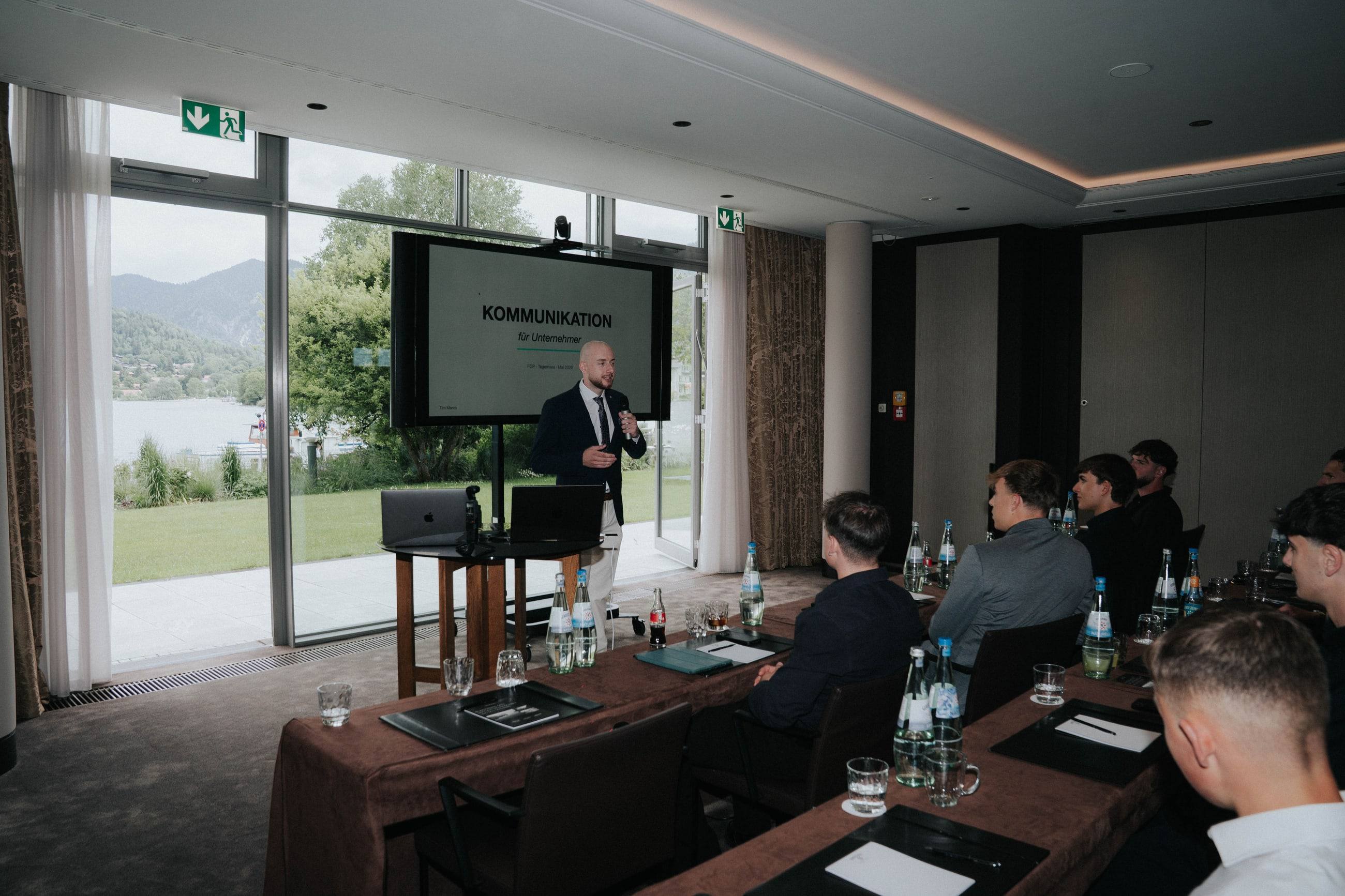
What stays after the training
More confidence for the next client contact.
In the training day, your employees work out concrete tools for their everyday work.
Personal action steps
Everyone notes which techniques they'll use more consciously from now on.
Shared conversation principles
Three to five guidelines for a reliable, client-focused approach.
Practical conversation tools
Compact materials, techniques and checklists for putting it into practice.
Awareness of your own impact
Feedback shows how body language, voice and conversation skills come across.
These results refer to the training day. In the impulse talk, participants get first communication tools and compact take-home materials.
Tailored to you
Your clients. Your situations. Your training.
We set the focus areas together, based on your real client situations.
- Consultations
- Client presentations
- Storytelling and communicating value
- Complaint handling
- Existing client support
- Asking for referrals
- Phone communication
- Tough questions and objections
FAQ
What you'll want to know before you reach out.
Which employees is the training for?
For employees with regular client contact, for example in consulting, customer service, sales, field sales or other client-facing roles.
Is this a classic sales training?
No. The focus is on professional communication, personal impact, client understanding and conversation skills. Winning new clients and keeping existing ones are equally relevant.
Do you take our products and services into account?
Yes. In the preliminary call, we agree on relevant client situations and training focus areas. The practical exercises can be built around them.
How many employees can take part?
The six-hour training day is designed for six to twelve participants. We can discuss other group sizes individually.
Are all six focus areas covered in one day?
No. They're a selection. The most important areas are explored in depth to fit your company and the training time available.
What's the difference between the impulse talk and the training day?
The impulse talk gives first insights and communication tools. In the training day, realistic client conversations are practiced intensively and improved through personal feedback.
Can the training continue over the long term?
Yes. If you'd like your employees to be supported over a longer period, separately agreed development support is possible.
Professional client conversations start with good preparation.
Let's find out together which communication skills matter most for your employees and your client contacts. In a short call, we clarify where you stand and find the right training format.